
Introduction
Anodizing is often discussed in terms of corrosion resistance, wear resistance, coating thickness, colour, and appearance. But for many precision aluminum components, an equally important question is where the anodized coating should not be allowed to develop.
A part may contain threaded holes that need to maintain their fit, precision bores with closely controlled dimensions, mating surfaces that cannot tolerate coating buildup, or electrical contact points that must remain conductive. In these situations, anodizing the entire component can create problems even when the coating itself is processed correctly.
Masking protects selected areas before anodizing so those features remain free of the anodic coating. When planned properly, it allows manufacturers to combine the performance benefits of anodizing with the dimensional and functional requirements built into the part.
What Is Masking in Anodizing?
Masking is the selective protection of areas that should not receive anodizing. Before processing, designated surfaces are covered, plugged, or coated with materials that can withstand the anodizing environment.
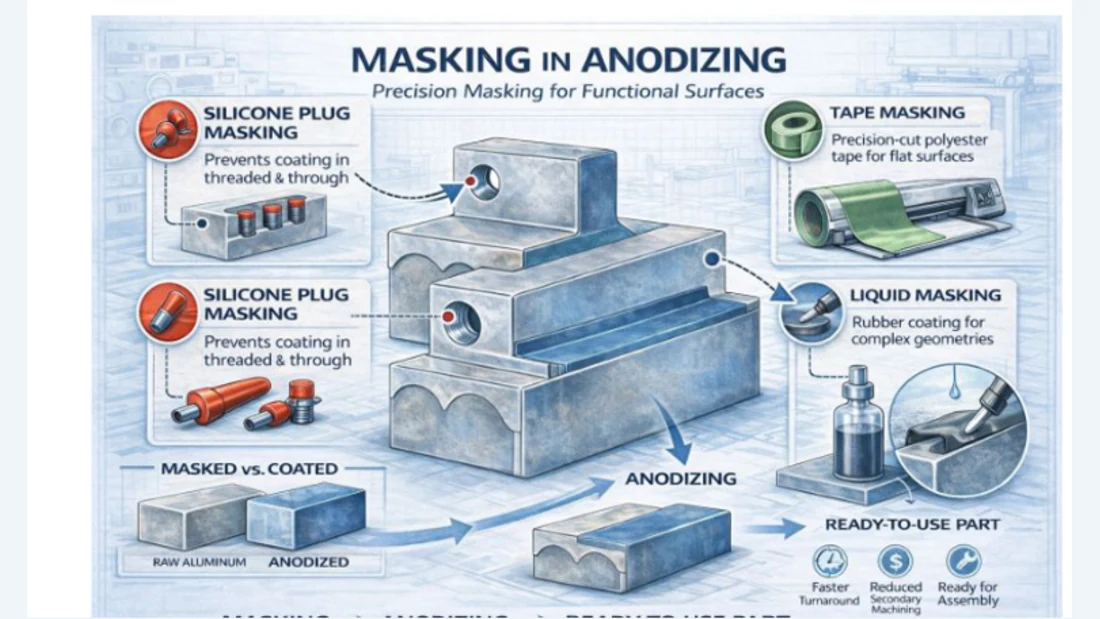
The masking method depends on the component geometry and drawing requirements. Threaded and through holes may be plugged, flat surfaces may be covered with precision-cut tape, and curved or irregular areas may require a liquid masking material.
The goal is to control exactly where the anodic coating is allowed to form so the finished part performs as intended.
Why Is Masking Important During Anodizing?
Anodizing changes the aluminum surface. Unlike paint or plating, the anodic oxide is formed from the aluminum itself through an electrochemical process. As the oxide develops, finished dimensions change.
That change may be small, but on precision components it can matter. Threads, bores, bearing locations, press-fit features, sealing surfaces, and close-tolerance mating areas may no longer fit as intended if coating buildup is not considered.
Masking is also important when a surface must remain electrically conductive. Anodized aluminum oxide is electrically insulating, so grounding points, contact pads, and certain assembly interfaces may need to remain free of anodizing.
In each case, masking protects a functional requirement rather than serving only a cosmetic purpose.
How Does Anodizing Affect Part Dimensions?
The Aluminum Anodizers Council explains that anodizing converts aluminum into aluminum oxide and changes finished dimensions. The amount of change depends on the process, alloy, coating thickness, and processing conditions.
This becomes especially important with Type III hard anodizing because the coating is typically thicker than conventional Type II sulphuric anodizing. At West-Tech, Type II coatings are processed from 0.0003 to 0.001 inch, while Type III hard anodizing is available from 0.001 to 0.003 inch.
Inside a precision bore or around a closely fitted feature, that dimensional change can directly affect assembly. A hole has coating growth around its circumference, so the finished diameter can decrease from both sides of the feature.
For this reason, engineers should consider coating thickness and selective masking together rather than treating them as separate decisions.
What Areas Commonly Need to Remain Uncoated?
Masking requirements vary, but common areas include:
- Threaded holes and through holes
- Precision bores and close-tolerance features
- Bearing, bushing, press-fit, mating, and sealing surfaces
- Grounding points and electrical contact surfaces
- Selected cosmetic or assembly areas
Not every one of these areas must always be masked. The drawing, coating thickness, tolerance, and intended function should determine what remains free of the anodic coating.
It is also important to distinguish between “uncoated” and “bare aluminum.” Depending on the specified process route, an area protected from anodizing may receive another treatment, such as chemical conversion coating, before masking. The drawing should define the required final condition.
What Masking Methods Are Used for Anodizing?
There is no single masking method for every geometry. The three primary methods used at West-Tech are silicone plug masking, polyester tape masking, and liquid rubber masking.
Silicone Plug Masking
Silicone tapered plugs and pull plugs are commonly used for threaded holes, through holes, and other openings. The plug creates a physical barrier that prevents the anodizing solution from reaching the protected area.
Precision Tape Masking
Polyester masking tape is useful for flat surfaces, defined boundaries, and custom profiles. Masking tape used for anodizing must withstand aggressive chemical processing while remaining adhered and removing cleanly afterward. Industry guidance from 3M similarly emphasizes chemical resistance, secure adhesion through the bath, clean removal, and controlled masking lines.
At West-Tech, custom tape profiles can be cut in-house using a plotter. This is particularly useful for complex shapes and repeat production where the same masking geometry must be reproduced consistently.
Liquid Masking
Curved, rounded, recessed, or irregular surfaces may not be suitable for tape. Liquid rubber masking can be applied to these areas to create a protective barrier through processing and removed after anodizing.
How Is the Correct Masking Method Selected?
The correct method depends on the anodizing type, required coating thickness, alloy, geometry, tolerance, masking boundary, quantity, and any downstream operations.
A threaded hole may be best suited to a silicone plug, while a large flat pad may be more efficiently protected with plotted tape. An irregular radius or complex transition may require liquid masking.
The best time to review these requirements is before production begins. Reviewing the drawing in advance allows the processor to identify potential masking challenges before parts reach the anodizing line.
What Should Engineers Specify on the Drawing?
Clear drawings reduce uncertainty during selective finishing.
Where masking is required, the drawing or purchase order should identify the applicable anodizing specification and type, required coating thickness, areas that must remain free of anodizing, critical dimensions or tolerances, threaded features, electrical contact or grounding areas, and any masking boundaries that are functionally important.
If the exact edge of a masked area is critical, that should be defined rather than left open to interpretation.
Providing this information allows the masking plan to be reviewed together with the anodizing process, which is especially important for aerospace, defence, hydraulic, electronics, and other precision applications.
Common Anodizing Masking Questions
Does anodizing affect part dimensions?
Yes. Anodizing converts the aluminum surface into an oxide layer, which changes finished dimensions. The effect is particularly important on bores, threads, mating surfaces, and other close-tolerance features. Type III hard anodizing normally creates a greater dimensional consideration than Type II because a thicker oxide layer is typically specified.
Do all threaded holes need to be masked before anodizing?
No. Whether a threaded hole should be masked depends on the anodizing type, coating thickness, thread dimensions, tolerance, and assembly requirements. Some designs allow for anodizing buildup, while others require the thread to remain free of coating. The drawing should clearly identify the intended condition.
Why are electrical contact and grounding areas masked?
The aluminum oxide created by anodizing is electrically insulating. If a part requires a conductive surface for grounding, electrical contact, or metal-to-metal connection, that location may need to remain free of anodic coating. Masking allows the surrounding surfaces to be anodized while protecting the functional contact area.
What information should be provided when requesting anodizing masking?
The processor should be provided with the aluminum alloy or material, quantity, applicable specification, anodizing type, required coating thickness, part dimensions, and a drawing clearly identifying the areas that must remain free of anodizing. Critical tolerances and important masking boundaries should also be identified.
Can masking create a perfectly sharp boundary between anodized and uncoated areas?
Masking can produce controlled and repeatable boundaries, but it still depends on material adhesion, geometry, handling, and processing conditions. Tape edges can lift, plugs can shift, and small amounts of solution can occasionally reach a masking boundary. When the exact transition line is critical, the acceptable boundary or tolerance should be discussed before production.
Masking Services at West-Tech Finishing
At West-Tech Finishing, masking and selective finishing are performed in-house as part of our aluminum finishing capabilities. Keeping masking together with anodizing and chemical conversion coating allows the process to be reviewed as one finishing route rather than a series of disconnected supplier operations.
Our process begins with the drawing. We review the material, applicable specification, anodizing type, coating thickness, geometry, and the features that must remain free of anodizing. The masking method is then selected based on the part.
Silicone tapered and pull plugs are used for threaded and through holes. Polyester tape is used for flat surfaces and defined profiles, with custom shapes cut on our in-house plotter when required. Liquid rubber masking is used for curved, uneven, or complex features where tape will not conform effectively. For polyester tape and liquid rubber applications, chemical conversion coating is applied first where required for proper masking adhesion.
Once masking is complete, the part moves through the specified finishing process. West-Tech provides both Type II sulphuric anodizing and Type III hard anodizing, with 11.5 ft x 4.5 ft x 2.5 ft anodizing tank capacity.
What helps West-Tech stand out is the ability to coordinate selective finishing within the same facility. Masking, chemical conversion coating, and anodizing can be planned together, reducing supplier handoffs and helping ensure the finishing sequence follows the drawing from start to finish. Our Nadcap accreditation, AS9100 Rev D and ISO 9001:2015 registered quality systems, and Controlled Goods registration further support customers working with aerospace, defence, and other demanding applications.
Masking timelines typically range from 1 to 2 weeks depending on the complexity of the masking and the time required to complete the work.
If your drawing includes selective anodizing or masking requirements, our team can review the material, specification, coating thickness, critical tolerances, and areas that must remain uncoated before processing with your request for quote.