
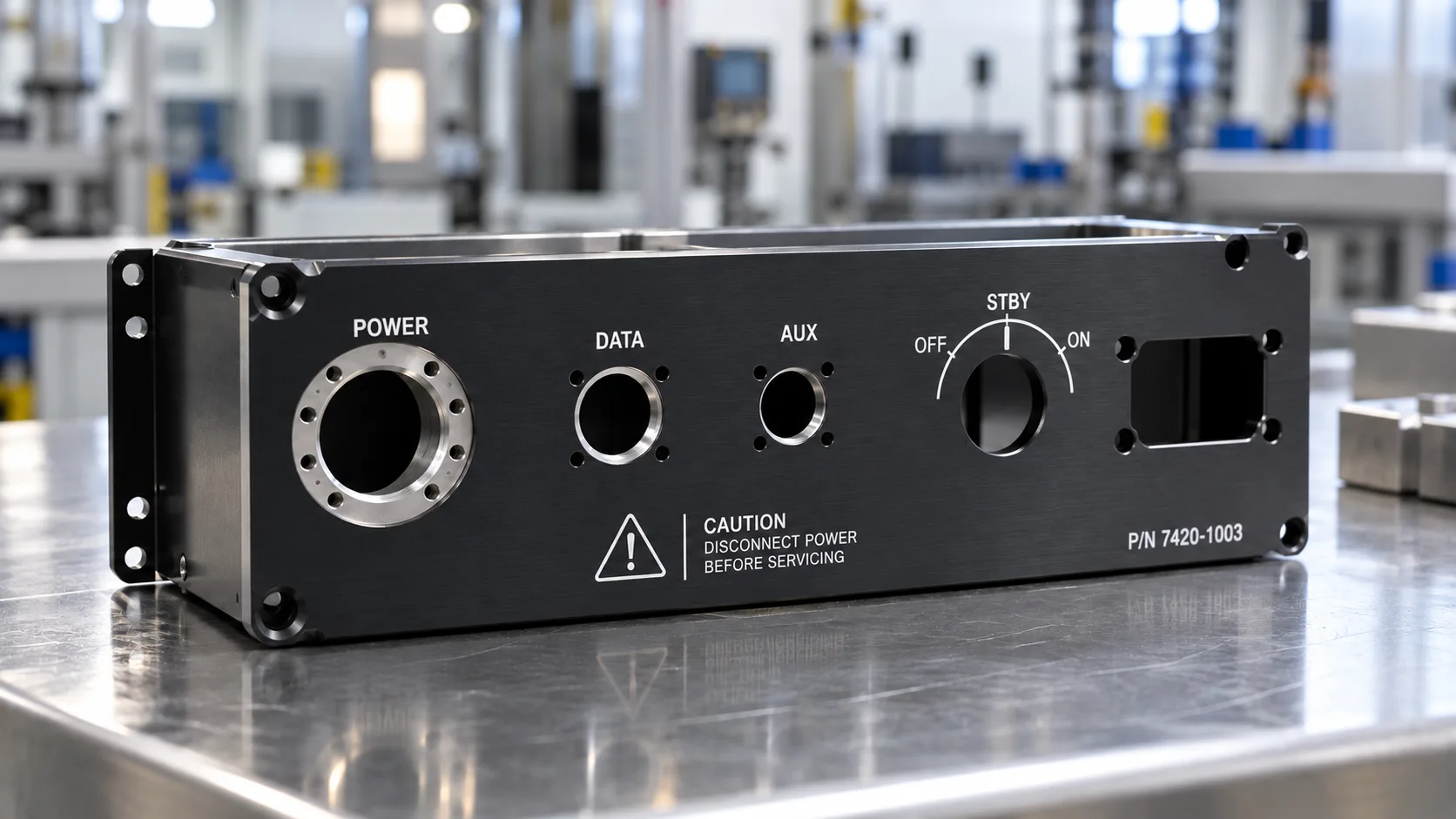
Silk screening may seem like a small final step in the manufacturing process, but on finished aluminum components, it can serve an important purpose.
Across aerospace, defence, automotive, and industrial applications, a perfectly anodized aluminum component isn’t always a finished one. These parts often require more than just the correct dimensions and surface finish. They may also need part identification, operating instructions, labels for switches and controls, warning text, symbols, or other significant markings that help communicate how it should be used.
This is where silk screening becomes extremely valuable. When applied to anodized aluminum surfaces, silk screening allows manufacturers to add clear, high-contrast markings directly to the finished component. The process can support both functional identification and visual consistency, making it especially useful for panels, enclosures, housings, controls, and other parts where information needs to remain easy to read.
In this article, we’ll look at how silk screening works, why it is commonly used on aluminum components, where it fits within aerospace, defence, automotive, and industrial manufacturing, and what should be considered before specifying it for a part.
What Is Industrial Silk Screening?
Industrial silk screening, also known as screen printing, is a process used to apply ink directly to the surface of a component.
A prepared screen acts as a stencil, allowing ink to pass through only in the areas that form the required letters, numbers, symbols, or graphics. The ink is transferred across the screen and onto the part, creating the specified marking.
Although the basic process is straightforward, industrial silk screening differs from decorative printing because the markings have to meet the requirements of the actual part. The customer drawing, approved artwork, ink colour, placement, condition of the finished surface, and where the part will be used can all affect how the job is completed.
For aluminum parts that also require anodizing, silk screening is generally completed after the required surface finish has been applied.
A typical sequence may be:
- 01Machining
- 02Anodizing
- 03Silk Screening
- 04Inspection
The exact sequence should always follow the engineering drawing, customer requirements, and any applicable specifications.
Why Silk Screening Works Well With Anodized Aluminum
Anodizing and silk screening serve two different purposes, but they often work well together.
Anodizing provides the required finish on the aluminum surface. Depending on the application, it can help improve corrosion resistance, resistance to wear, electrical properties such as insulation, and the overall appearance of the part.
What anodizing does not provide is information.
An anodized panel does not tell an operator which switch controls a particular function. A finished enclosure does not automatically identify its connectors. A housing does not display its part number, warning information, or operating instructions.
Silk screening allows that information to be added directly to the finished component.
For example, a black anodized control panel may use white silk-screened labels around switches and indicator lights.
Because silk screening is performed after the surface finishing process, the marking can be designed around the finished appearance of the component while maintaining the underlying anodized surface.
This makes silk screening well suited to panels, housings, faceplates, enclosures, and other components that require clear, consistent identification.
Silk Screening in Aerospace and Defence Applications
In aerospace and defence manufacturing, part identification can be much more than a branding decision. Depending on the program, drawing, or contract, marking may form part of the controlled manufacturing requirements for the component.
For example, MIL-STD-130 addresses identification marking requirements for U.S. military property when the standard is contractually specified. The focus is on ensuring required identification remains legible and sufficiently permanent for the expected service conditions of the item.
Aerospace drawings may also reference standards such as SAE AS478, which provides requirements and guidance for how parts are identified and marked.
These standards do not mean that every silk-screened component is automatically considered compliant with a military or aerospace specification. The drawing, purchase order, customer requirements, ink, marking method, location, and inspection requirements ultimately determine what the finished part must meet.
Within these industries, silk screening may be used for connector labels, switch functions, warnings, equipment names and identification, directional arrows, and other information that operators need to clearly read.
An aerospace equipment panel, for example, may require an anodized aluminum finish along with clear operating legends. A defence electronics enclosure may require identification around switches or connection points.
The goal is not simply to add graphics to the part. The marking needs to stay clear, readable, and appropriate for the conditions where the component will actually be used.
Automotive and Industrial Applications
The same need for clear component identification exists in automotive and industrial manufacturing.
Silk screening can be useful anywhere an operator, technician, or end user needs information to remain visible directly on a finished component. Applications can include specialty-vehicle control panels, aluminum bezels, equipment faceplates, machine interfaces, housings, and enclosures.
These environments can also introduce their own durability considerations.
Automotive components, for example, may experience repeated handling, temperature changes, exposure to light, cleaning products, or other environmental conditions. Standards such as SAE J2412 and SAE J2527 demonstrate the types of environmental exposure that may be considered for automotive interior and exterior materials when required by an OEM or customer specification.
The important point is that durability should never simply be assumed. The marking requirements should reflect where and how the finished component will actually be used.
What Determines the Durability of a Silk-Screened Marking?
The performance of a silk-screened marking depends on more than the fact that it has been applied to aluminum.
Several factors affect how well a silk-screened marking will hold up over time. These include the finished surface, how clean the part is before printing, the type of anodizing, the type of ink being used, how the ink is dried and hardened, and the conditions the part will face during use.
A marking used on an indoor control panel may face very different conditions than one installed on equipment exposed to oils, fuels, cleaning chemicals, abrasion, UV light, or changing temperatures.
Industrial screen-printing inks can be tested for how well they stick to the surface, how well they resist scratching and wear, how they react to chemicals, and how they perform under different temperatures. However, the performance of one ink system should not be assumed to apply to every part or operating environment.
If a component will be exposed to specific chemicals, aggressive cleaning procedures, outdoor weather, fuels, hydraulic fluids, unusual temperatures, or other demanding conditions, those requirements should be communicated before processing.
That gives the finishing supplier a clearer understanding of what the completed marking is expected to withstand.
Silk Screening vs. Laser Engraving
Silk screening and laser engraving can both be used to identify aluminum components, but the two processes are suited to different types of marking.
Silk screening works particularly well for repeated, fixed information. This can include operating legends, warning text, arrows, logos, symbols, connector labels, and larger groups of information. It also provides the ability to use a specified ink colour, which can create strong contrast against the finished surface.
Laser engraving is often better suited to permanent information that changes from one part to another, such as serial numbers, lot numbers, barcodes, Data Matrix codes, which are small machine-readable codes used to store identification and tracking information, and other information used to identify and track individual parts.
The two processes do not necessarily have to compete. A finished aluminum control panel, for example, could use silk screening for its fixed operating instructions while using laser engraving for a unique serial number or traceability code.
At West-Tech Finishing Inc., both silk screening and laser engraving are available, allowing the marking process to be selected according to the drawing and final application.
What Should Be Included in a Silk Screening Request for Quote (RFQ)?
Providing clear information when requesting a quote makes it easier for the finishing supplier to review the silk-screening requirements along with the rest of the finishing process.
When requesting silk screening, customers should consider providing:
- Part material, dimensions, and quantity
- Engineering drawing and current revision
- Required anodizing or other surface finish
- Approved artwork
- Exact marking content, position, and orientation
- Required ink colour
- Applicable customer or industry specifications
- Environmental, durability, inspection, or testing requirements
- Any serial numbers, barcodes, or other information that changes from one part to another
Placement can be particularly important for control panels and similar components. Text, symbols, and arrows may need to align accurately with switches, connectors, machined holes, displays, windows, or other features.
Including the silk-screening requirements with the drawings and quote request from the beginning allows the entire finishing process to be reviewed together, rather than treating the marking as an afterthought.
Frequently Asked Questions About Silk Screening
Are there specific ink requirements for aerospace and defence components?
Yes. Aerospace and defence components can require specific ink systems depending on the engineering drawing, customer specification, or program requirements.
The required ink may need to meet defined standards for adhesion, durability, chemical resistance, environmental exposure, or legibility. For that reason, the applicable requirements should always be reviewed before the marking process is selected.
Can silk screening be applied after anodizing?
Yes. Silk screening is commonly applied after anodizing when an aluminum component requires visible text, symbols, operating legends, warning information, logos, or other fixed graphics. The required processing sequence should always follow the customer drawing and applicable specifications.
How is ink adhesion and durability tested and verified?
Ink adhesion and durability are tested based on the requirements of the part, drawing, or applicable specification.
Depending on the application, testing may evaluate factors such as adhesion, abrasion resistance, chemical resistance, temperature exposure, or environmental durability. The exact tests and the requirements the marking must pass should always follow the customer drawing, specification, or program requirements.
How durable is silk screening on aluminum?
Silk screening can provide durable markings on aluminum and anodized aluminum when the surface preparation, ink system, and curing process are appropriate for the application.
The expected service environment should always be considered, especially if the part will be exposed to scratching or repeated wear, chemicals, cleaners, temperature changes, or outdoor conditions.
When should I use silk screening instead of laser engraving?
Silk screening is a strong choice for fixed, highly visible markings such as operating legends, warning text, symbols, logos, and control-panel graphics.
Laser engraving is often better suited to permanent identification and variable information such as serial numbers, lot codes, barcodes, and Data Matrix codes. The correct method depends on the drawing and application requirements.
Silk Screening at West-Tech Finishing
At West-Tech Finishing Inc., we provide silk screening for aluminum, anodized aluminum, and other finished metal components requiring clear and consistent identification.
Our silk screening services can be coordinated with anodizing and other finishing processes, allowing customers to manage surface finishing and final marking requirements through the same supplier.
We work from customer-supplied drawings and artwork, with inks and colours selected according to the part material, applicable specifications, and project requirements.
Our standard lead time is approximately 4–5 business days, with expedited service available when required.
If your next project requires anodizing, silk screening, laser engraving, or a combination of finishing and identification processes, send us your drawings, specifications, artwork, and RFQ. Our team will review your requirements and help determine the appropriate finishing and marking approach.