
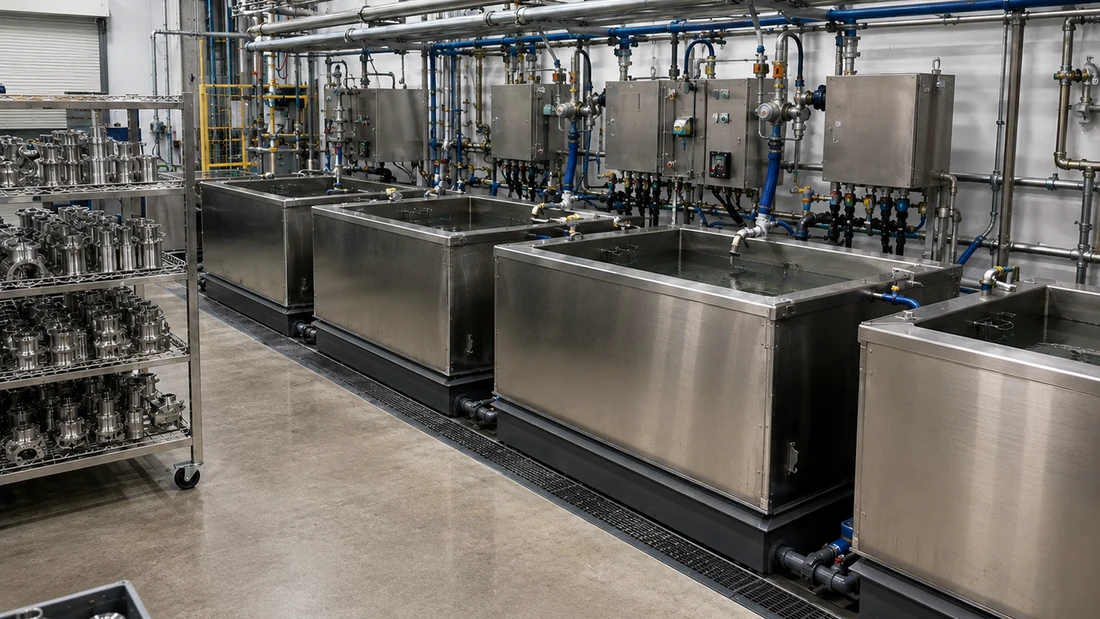
Introduction
Stainless steel is known for its corrosion resistance, but that does not mean every stainless-steel part is fully protected after machining, grinding, fabrication, or handling.
These manufacturing processes can leave free iron and other contaminants on the surface. Over time, those particles may oxidize and cause rust staining or localized corrosion, even when the stainless steel itself is properly specified for the application.
This is why passivation is used.
Passivation is a controlled chemical treatment used to remove free iron and other surface contaminants from stainless steel, helping restore the clean surface needed for the material to maintain its natural corrosion resistance.
Unlike plating, painting, or anodizing, passivation does not intentionally add a coating or measurable buildup. Instead, it leaves the stainless surface clean so the alloy can establish and maintain the chromium-rich passive condition responsible for its corrosion resistance.
Why Can Stainless Steel Still Rust?
Stainless steel gets much of its corrosion resistance from chromium in the alloy. When a clean stainless-steel surface is exposed to oxygen, a very thin chromium-rich oxide layer forms naturally. This passive layer helps protect the underlying metal from corrosion.
The problem is that manufacturing can compromise the condition of that surface.
Machining, grinding, forming, fabrication, tooling, and contact with carbon steel can transfer free iron and other contaminants onto the surface. If they are not removed, those particles can oxidize when exposed to moisture and oxygen, creating rust staining that can make it appear as though the stainless steel itself is corroding.
Passivation removes these surface contaminants and helps restore the conditions needed for the stainless steel to maintain its natural corrosion resistance.
However, passivation is not a solution for every corrosion issue. The performance of a stainless-steel component still depends on factors such as the alloy selected, its operating environment, exposure to chlorides, welding or heat treatment, post-process handling, and the design of the part itself.
Passivation works best as part of a properly specified manufacturing and finishing process.
| Operation | Primary purpose | Typical material removed | Relationship to passivation |
|---|---|---|---|
| Cleaning/ degreasing | Remove oil, shop soils, polishing compounds and organic contamination | Dirt, oil, residues | Often required before acid treatment |
| Descaling | Remove adherent oxide/scale | Oxide scale | May be necessary before passivation |
| Pickling | Remove scale, weld heat tint and a thin surface layer | Oxides plus some base metal | More aggressive than passivation |
| Passivation | Remove free iron/less-noble contamination and establish a chemically clean passive condition | Primarily contaminants rather than an intentional bulk-metal removal | Final corrosion-resistance preparation step |
How Does Stainless Steel Passivation Work?
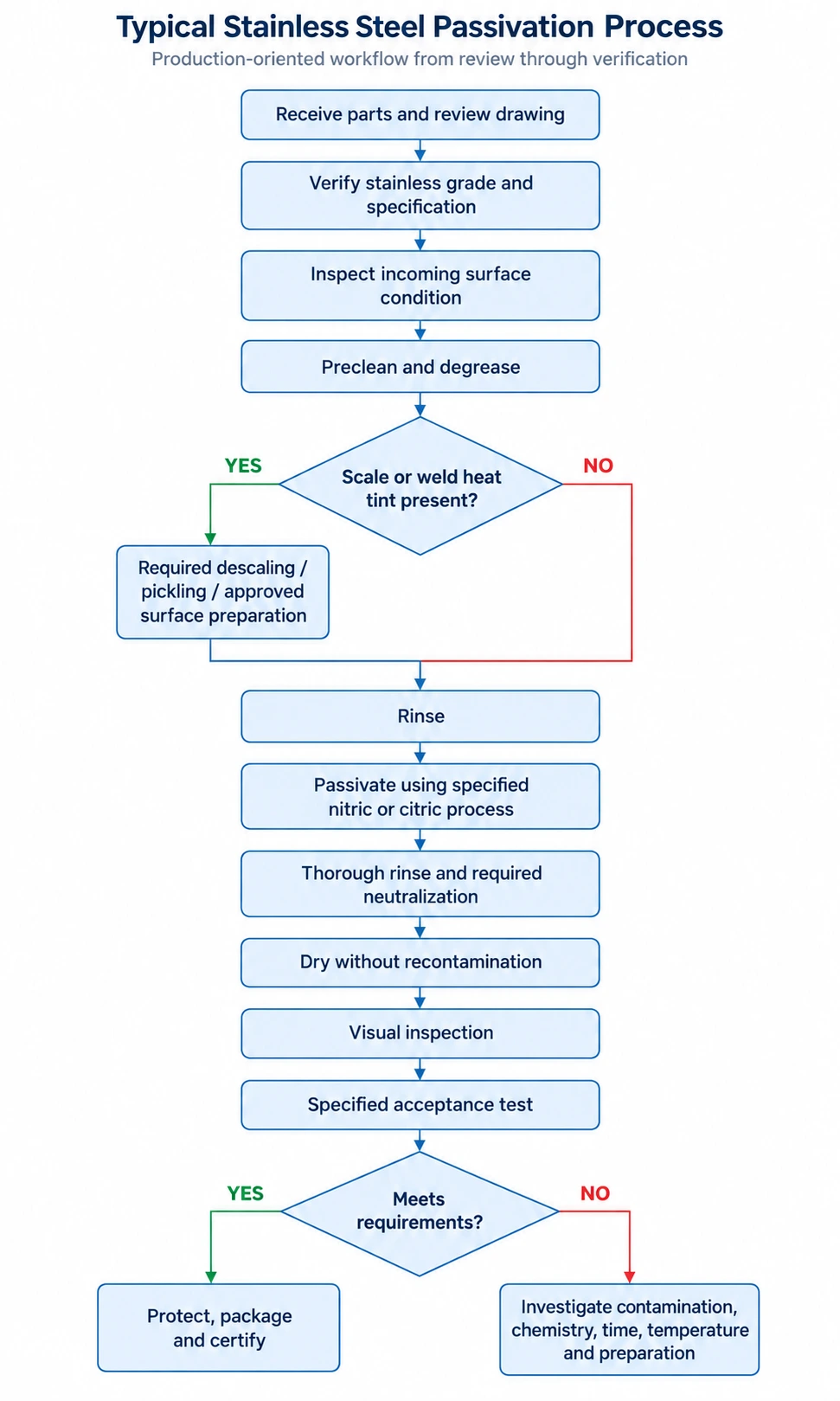
The exact passivation process depends on the stainless-steel grade, drawing requirements, applicable specification, required chemistry, and any testing or verification requirements. In most cases, however, the process follows a similar sequence.
It begins with reviewing the part and confirming the stainless alloy, governing specification, required nitric or citric treatment, and the condition of the incoming surface.
The component is then thoroughly cleaned to remove oils, machining fluids, polishing compounds, shop soils, and other residues that could interfere with treatment. If scale, heavy oxide, or weld heat tint is present, additional preparation such as descaling or pickling may also be required.
Once the surface is properly prepared, the part is treated using the specified nitric or citric passivation process. It is then thoroughly rinsed, carefully dried to avoid recontamination, and visually inspected. When required by the drawing or specification, additional testing is performed to verify the finished surface.
Passivation is therefore more than simply placing stainless steel into an acid bath. It is a controlled finishing process that depends on proper preparation, treatment, rinsing, handling, and verification at each stage.
Nitric vs. Citric Acid Passivation
Nitric acid and citric acid are both recognized methods for stainless steel passivation, and neither should automatically be considered better than the other.
Nitric acid has a long history of use in stainless steel processing, including aerospace and other demanding manufacturing applications. It removes free iron from the surface and, because it is a strong oxidizing acid, also supports the development of the passive condition on properly prepared stainless steel.
Its advantages include decades of industrial use, well-established process families, and recognition within major passivation specifications. However, nitric acid also requires careful process control due to its corrosive and oxidizing nature.
Citric acid removes free iron primarily through complexation or chelation. Once the contamination is removed, the clean stainless-steel surface can naturally re-establish its chromium-rich passive layer.
Citric processes generally offer a milder chemical handling profile and can avoid some concerns associated with certain nitric-based formulations. However, this does not make citric acid universally superior or suitable for every component.
The correct method depends on the stainless alloy, drawing requirements, governing specification, customer or OEM requirements, process qualification, and any required acceptance testing.
| Attribute | Nitric passivation | Citric passivation |
|---|---|---|
| Fundamental action | Dissolves free iron using strong oxidizing chemistry and promotes the formation of a passive surface. | Chelates and complexes free iron; the clean surface then naturally establishes a passive condition. |
| Standard recognition | ASTM A967 and AMS 2700 | ASTM A967 and AMS 2700 |
| Typical standardized concentration | Typically 20–55 vol% nitric acid (HNO₃) depending on treatment family; some families include dichromate. | Common A967 treatment families use 4–10 wt% citric acid. |
| Typical temperature range | Typically 70–140°F for common A967 straight-nitric treatments. | Typically 70–160°F for common A967 citric treatments. |
| Typical minimum treatment times | Typically 20–30 minutes for common A967 nitric treatment families. | Typically 4–20 minutes for the principal published A967 citric families. |
| Oxidizing strength | High (strong oxidizing acid). | Mild (citric acid is not a strong oxidizing mineral acid). |
| Free-iron removal mechanism | Acid dissolution under strong oxidizing conditions. | Iron chelation and complexation remove free iron from the surface. |
| Worker/process hazard | Higher acid strength and oxidizer mean greater fume exposure and chemical hazard. | Generally lower acute chemical hazard, although it is still an acid process requiring appropriate controls. |
| Cr(VI) issue | Some nitric formulations may include dichromate, which contains Cr(VI); straight nitric systems do not. | Ordinary citric formulations avoid dichromate unless a separately qualified chemistry specifies otherwise. |
| Risk of surface attack | Possible if chemistry, alloy, temperature, time, or agitation are outside approved limits. | Generally milder, but poor process selection or control can still cause unacceptable surface effects. |
| Wastewater consideration | Requires neutralization and dissolved metals removal; dichromate processes add chromium-management complexity. | Acid and dissolved metals still require treatment; citrate complexes metals, which can affect conventional metal precipitation. |
What Standards Apply to Stainless Steel Passivation?
Three documents are especially relevant in precision manufacturing: ASTM A967/A967M, ASTM A380/A380M, and AMS 2700.
ASTM A967 is the most direct chemical passivation specification. It covers nitric, citric, and other recognized treatment approaches, along with qualitative methods that can be used to verify removal of contaminant iron and evaluate the finished surface.
ASTM A380 is broader. It covers cleaning, descaling, pickling, and passivation of stainless steel parts, equipment, and systems. It is particularly useful for understanding surface preparation and contamination control before and after passivation.
AMS 2700 is especially important in aerospace work. It addresses passivation of corrosion-resistant steels with the objective of assuring removal of free iron and other less-noble contaminants.
These documents often cover similar requirements, but they are not all the same. The drawing, purchase order, customer requirements, and the correct specification revision ultimately determine how the job needs to be processed.
How Is Passivation Tested?
A stainless component can look clean and still have surface contamination, so visual inspection alone may not always be enough.
Depending on the governing requirement, verification methods can include copper sulfate, salt spray, high humidity, water immersion, or other specified tests.
Copper sulfate testing can be used to check for free iron left on the surface by producing a visible reaction. It can be a useful verification method, but it is not suitable for every stainless-steel grade or application.
Salt spray testing takes a different approach by exposing the part or test specimen to a controlled salt-fog environment. When required, it can be used to evaluate corrosion resistance, but the results should not be treated as a direct estimate of how long a part will last in service.
For engineers and buyers, the main point is that the required test should come from the applicable specification or customer requirements. Not every passivated part needs the same type of verification.
When Should Stainless Steel Be Passivated?
Passivation is commonly used for stainless steel components where corrosion resistance, cleanliness, and surface condition are important.
Typical examples include machined fittings, valve bodies, manifolds, shafts, fasteners, brackets, actuator components, fluid-handling parts, and aerospace or defence hardware.
Whether passivation is needed depends on the part, its intended use, and the requirements set for the job. In many controlled manufacturing applications, it is specified as part of the finishing process to help ensure the stainless steel performs as intended.
Common Passivation Questions
Does passivation add thickness?
No. Passivation does not intentionally deposit a coating or create measurable buildup in the way plating or anodizing does. This makes it suitable for components where dimensional tolerances are important.
What information should be provided when requesting passivation?
The processor should be provided with the stainless-steel grade, applicable drawing or specification, required nitric or citric process if specified, and any testing or verification requirements. Providing this information helps ensure the correct process is used.
How can you tell if a stainless-steel part has been passivated?
Passivation typically does not produce an obvious visible change to the surface. Because there is no deposited coating, verification is usually based on process records, certification, and any testing required by the applicable specification rather than appearance alone.
Can a part become contaminated after passivation?
Yes. Contact with carbon steel, ferrous dust, contaminated tools, dirty fixtures, or improper storage can reintroduce free iron or other contaminants after processing. Proper handling and storage are important for maintaining the condition of the passivated surface.
Stainless Steel Passivation at West-Tech Finishing
At West-Tech Finishing Inc., passivation is treated as a controlled manufacturing process from the moment a part enters our facility through final verification. We provide both nitric and citric passivation to applicable ASTM A967, ASTM A380, and AMS 2700 requirements, with each job processed according to the stainless-steel grade, drawing, specification, and required acceptance criteria.
Quality control is an important part of that process. Salt spray and copper sulfate verification are performed in-house when required, allowing processing and testing to remain under one roof and reducing reliance on additional outside suppliers. This is particularly valuable for precision components where documentation, consistency, and verification are just as important as the chemical treatment itself.
West-Tech’s quality management system is certified to AS9100D and ISO 9001:2015, with its certified scope specifically including passivation for aviation, defence, automotive, and commercial applications. That combination of controlled processing, recognized specifications, in-house verification, and established quality systems allows us to handle passivation work from prototypes through full production with consistent, repeatable results.
For quoting or process review, providing the stainless-steel grade, drawing or specification, part dimensions, quantity, and any testing or certification requirements with your request for quote will allow our team to review the requirements before production and determine the appropriate passivation and verification process.