

Introduction
In aerospace manufacturing, a finished component cannot always be judged by appearance alone. Processes such as anodizing and chemical conversion coating can directly influence corrosion resistance, wear performance, electrical characteristics, dimensional tolerances, and the long-term reliability of a part.
Much of that performance depends on how consistently the finishing process is controlled, monitored, and documented, not simply on how the surface looks when the component leaves the finishing line. For aerospace manufacturers, this makes process control and independent oversight especially important, which is where Nadcap accreditation plays a critical role.
Nadcap is an industry-managed accreditation program for critical processes used throughout the aviation, defence, and space supply chain. It was developed to create a common technical approach to auditing special-process suppliers, giving participating aerospace companies a consistent way to evaluate whether process controls meet defined industry requirements.
For engineers, quality teams, and procurement professionals sourcing metal finishing, understanding what Nadcap actually means is important. It helps separate the accreditation itself from the drawing, specification, customer approval, and supplier scope that still control each job.
What Is Nadcap Accreditation?
Nadcap is administered by the Performance Review Institute, or PRI. The program brings aerospace, defence, and space companies together with suppliers, technical experts, and process auditors. Participating Subscriber companies help establish the audit criteria for the critical processes they rely on, while PRI manages audit scheduling, auditor assignment, technical review, and program administration.
A supplier does not receive a blanket approval for everything it does. Nadcap accreditation is tied to a defined process scope. Accredited suppliers are listed through PRI’s Qualified Manufacturers List, or QML, where customers can confirm the processes and services covered by the current accreditation.
This scope-specific approach is important in metal finishing. A company may provide several surface-treatment services, but customers should verify that the exact process required by the drawing or purchase order falls within the supplier’s current approved Nadcap scope.
Why Does Nadcap Matter in Aerospace Manufacturing?
Many special processes cannot be fully verified through final visual or dimensional inspection. A part can appear acceptable while its actual performance still depends on chemistry, temperature, time, electrical settings, preparation, sealing, testing, equipment condition, operator qualification, and documentation.
Nadcap addresses that challenge by auditing the controls behind the process. Before the program existed, individual aerospace manufacturers often maintained their own separate audit requirements, which could result in suppliers undergoing multiple audits for similar work. Nadcap created a shared industry-managed framework in which standardized technical audits can be accepted by participating Subscribers.
For customers, the value is not that Nadcap guarantees a perfect part. It is that the supplier’s accredited process has been assessed against detailed, industry-developed requirements and remains subject to periodic reaccreditation and technical oversight.
How Is Nadcap Different From AS9100?
Nadcap and AS9100 are both widely used in aerospace manufacturing, but they address different layers of quality.
AS9100 is a quality management system standard for aviation, space, and defence organizations. It addresses the broader systems an organization uses to manage quality, including areas such as leadership, risk, documented information, production controls, corrective action, and continual improvement.
Nadcap is process-specific. A Nadcap Chemical Processing audit examines the technical controls associated with the special processes included in the audit scope. For chemical processing, PRI uses the AC7108 family of audit criteria and applicable supplemental checklists. In practical terms, AS9100 looks broadly at the organization’s quality management system, while Nadcap goes deeper into the controls behind a particular critical process. The two complement each other rather than replacing one another.
What Does a Nadcap Chemical Processing Audit Evaluate?
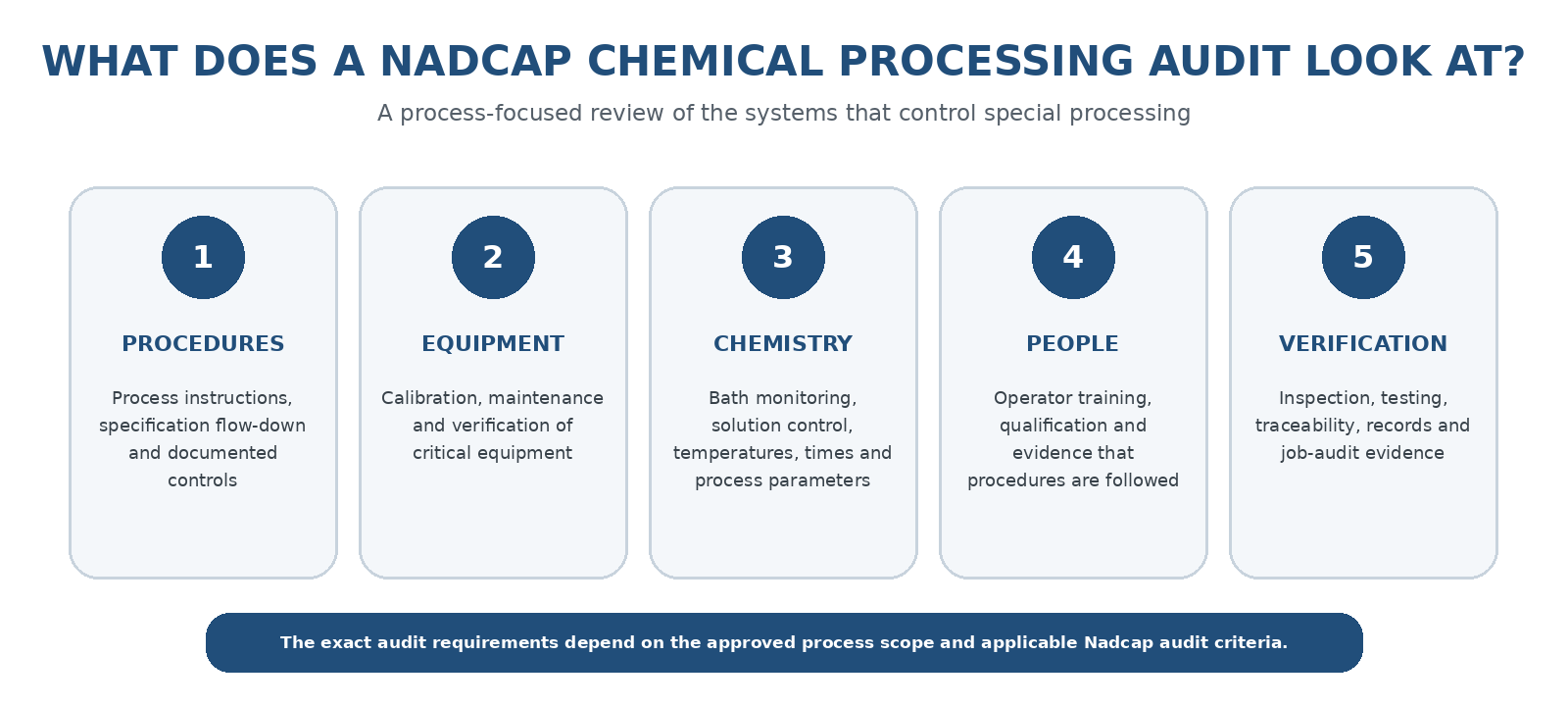
A Nadcap audit goes beyond confirming that a written procedure exists. Auditors evaluate whether the required controls are established, current, followed in production, and supported by objective records.
Depending on the process scope and applicable checklist, the review can include process procedures and specification flow-down, equipment calibration and maintenance, solution and chemistry control, operator training and qualification, inspection and testing, traceability, record retention, corrective action, and previous audit history.
Job audits are also an important part of the assessment. They allow the auditor to follow actual production work and compare what is happening on the floor with the documented procedure and applicable requirements. For a chemical-processing supplier, this helps connect the quality system to the real conditions under which aerospace parts are processed.
What Is Nadcap Merit Status?
Nadcap accreditation is not permanent. Suppliers undergo periodic reaccreditation audits and must continue meeting the applicable program requirements. Standard audit cycles can be extended when a supplier meets the defined Merit criteria for its commodity.
PRI materials recognize 18-month and 24-month Merit accreditation cycles in parts of the Nadcap program. Merit does not create a different engineering specification for a customer’s part, nor does it expand the supplier’s accredited scope. Instead, it extends the accreditation cycle based on qualifying performance within the program.
In practical terms, Merit status reflects a sustained level of performance within the Nadcap program. It recognizes suppliers that have demonstrated the consistency and audit history required to qualify for a longer accreditation cycle while remaining accountable to the same technical requirements and scope controls.
What Does “Zero Findings” Mean?
During a Nadcap audit, a nonconformance is issued when the auditor identifies a condition that does not meet an applicable audit requirement. Completing an audit with zero findings means that no audit nonconformances were issued during that assessment.
This is significant because Nadcap audits examine technical process controls in considerable detail. However, a zero-finding audit should not be interpreted as a guarantee that production issues can never occur. Aerospace quality still depends on maintaining process discipline, correctly reviewing drawings and specifications, controlling each production lot, and responding appropriately when conditions change.
The value of a zero-finding audit is that it demonstrates the strength of the audited system at the time of assessment and supports confidence in how those process controls were being maintained.
What Should Customers Verify When Choosing a Nadcap Supplier?
Nadcap can be an important supplier-qualification requirement, but it should always be considered alongside the complete technical requirements for the part.
Customers should confirm a supplier’s current accreditation status and scope, then compare that scope with the drawing, material, process specification, coating type or class, testing requirements, and any customer-specific approvals. Some aerospace manufacturers also maintain their own approved-source lists in addition to Nadcap requirements.
Nadcap does not replace the drawing, purchase order, or OEM-specific requirements. Instead, it serves as one important layer of supplier qualification that should align with the exact process and specifications being purchased.
Common Nadcap Questions
Is Nadcap a certification or an accreditation?
PRI uses the term accreditation. Nadcap accreditation applies to defined critical processes and services that have been assessed through the Nadcap program. Although the phrase ‘Nadcap certified’ is sometimes used conversationally, ‘Nadcap accredited’ is the more accurate term.
Does Nadcap accreditation cover every process a supplier offers?
No. Nadcap is scope-specific. A supplier can provide several finishing services while only certain processes are included in its current Nadcap accreditation. Customers should verify the current QML scope against the work required on the drawing or purchase order.
Does Nadcap replace AS9100 or customer-specific approvals?
No. AS9100 addresses the broader quality management system, while Nadcap focuses on specific critical processes. Customers may also require separate OEM approvals, approved-source status, or specification-specific qualifications.
What does Nadcap Merit status mean for a customer?
Merit indicates that the supplier has qualified for a longer Nadcap accreditation cycle under the applicable program criteria. It does not change the engineering requirement on the customer’s part and does not expand the accredited scope. The current process specification and approved scope still control the job.
Nadcap Chemical Processing at West-Tech Finishing
At West-Tech Finishing, Nadcap Chemical Processing accreditation supports our work for aerospace, defence, and precision manufacturing customers from our Vaughan, Ontario facility.
Our broader finishing capabilities include Type II sulphuric anodizing, Type III hard anodizing, chemical conversion coating, and in-house masking and selective finishing. These capabilities are supported by our AS9100 Rev D and ISO 9001:2015 registered quality systems, along with compliance with Canada’s Controlled Goods Program requirements.
Our latest Nadcap audit resulted in zero findings, and our current Chemical Processing accreditation has been awarded Nadcap Merit status with an 18-month accreditation length. Our current certificate expires May 31, 2028.
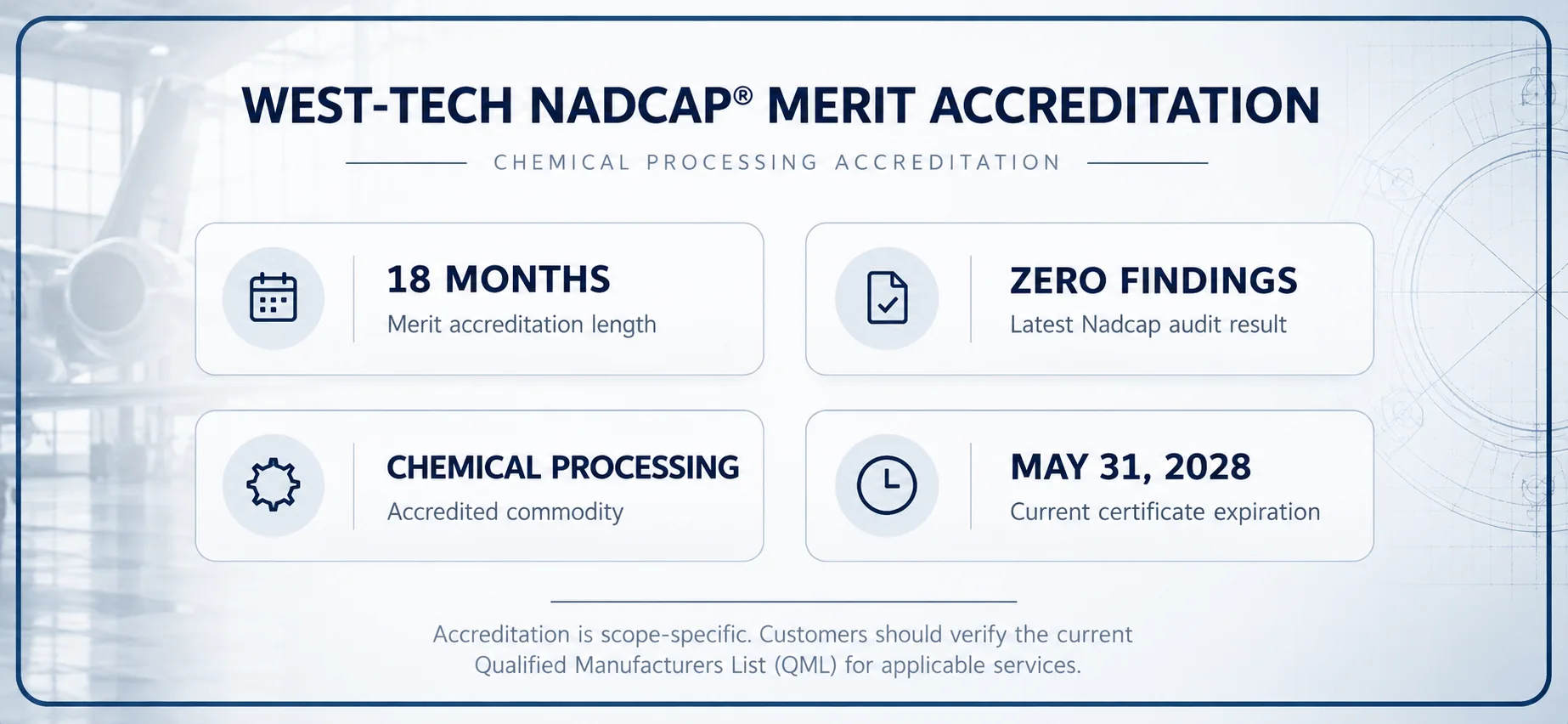
For customers, the significance goes beyond the certificate itself. It reflects the process discipline behind the work, including controlled procedures, monitored process conditions, trained personnel, inspection and testing, traceability, and continued accountability to aerospace special-processing requirements.
Because Nadcap accreditation is scope-specific, customers should confirm that the required process falls within the current accredited scope. If your drawing calls for Nadcap-accredited chemical processing, send us the alloy, specification, process callout, quantity, part dimensions, masking requirements, and any customer-specific approval requirements. Our team can review the requirement against our current accredited scope before production begins.