
Introduction
When a buyer sends an RFQ, the goal is usually straightforward: get an accurate price, understand the lead time, and keep the project moving.
But providing an accurate finishing quote requires more than simply knowing which process is needed. Details such as the alloy, drawing revision, finishing specification, masking requirements, critical dimensions, certifications, additional services, and delivery expectations all help our team understand exactly what the job requires.
When that information is provided upfront, we can spend less time going back and forth for clarification and more time reviewing the job and preparing an accurate quote.
For procurement teams, that means a smoother process and a faster path toward getting the parts into production.
Why Complete RFQs Move Through Quoting Faster
The fastest finishing quotes usually start before the RFQ is sent.
A supplier can review a job quickly, but the quotation may still slow down if important information is missing. A drawing may say “anodize,” for example, without identifying the required type, class, colour, thickness, or masking requirements.
The same issue can happen when the alloy is unclear, the revision is missing, a critical bore does not indicate whether the dimension applies before or after finishing, or certification requirements are added later.
Each unanswered question creates another step. The supplier reviews the package, identifies what is missing, sends the question back to the buyer, and may then need to wait while engineering or quality confirms the requirement.
Providing the right information upfront helps remove those extra steps. It gives the finishing team a clearer understanding of the part and its requirements from the beginning, making it easier to review the job accurately and move the quotation forward.
Start With the Current Drawing and Material
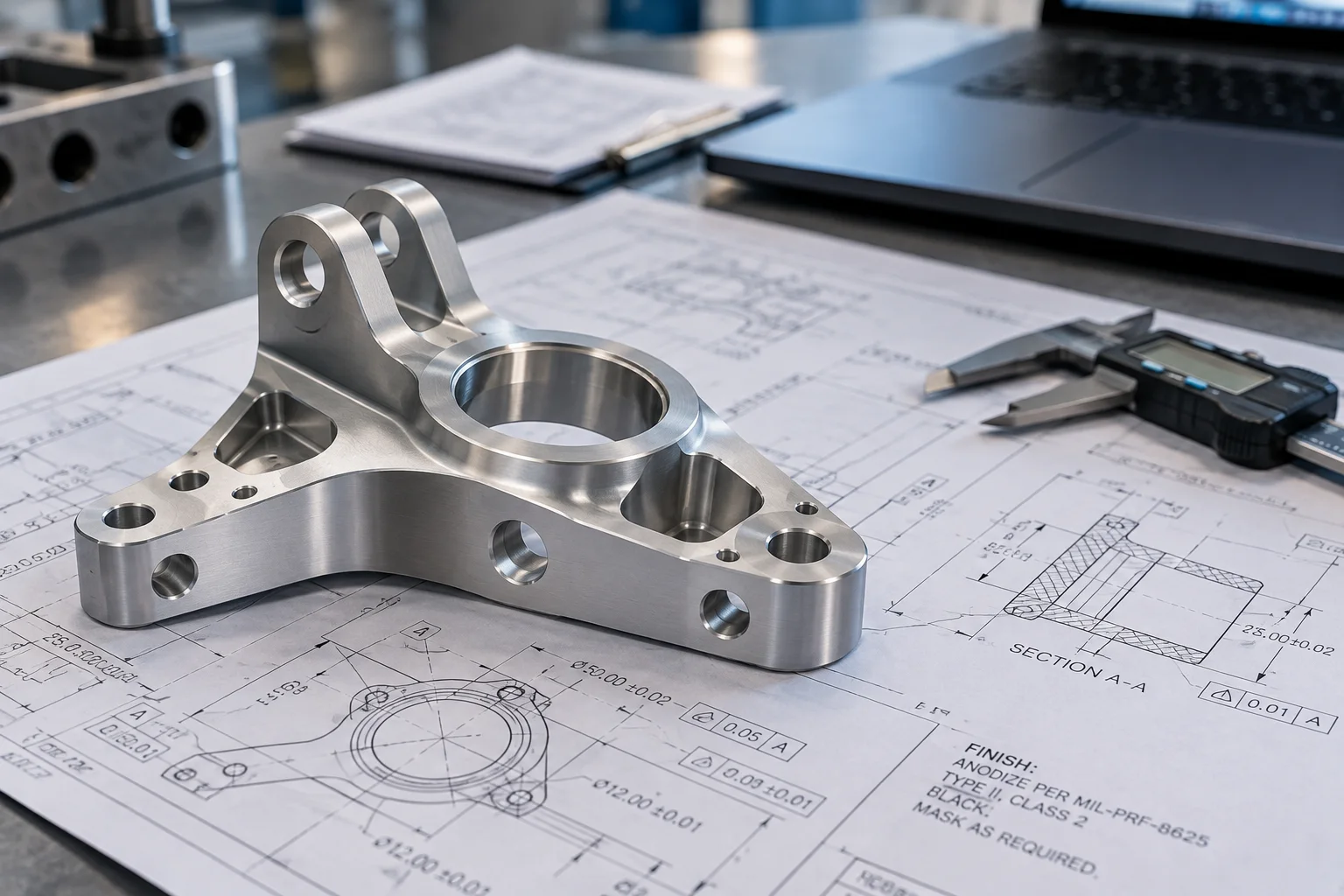
The drawing is one of the most important parts of the RFQ package. It tells the finishing supplier what the part is, which surfaces matter, what dimensions are critical, and how the finishing requirement fits into the design.
Sending an outdated drawing can create confusion if masking areas, dimensions, notes, or finish callouts have changed. The RFQ should include the current controlled drawing and clearly identify the revision.
The material should also be specific. “Aluminum” is not always enough information for an anodizing quote. Different aluminum alloys can respond differently during anodizing, so the alloy and temper should be identified whenever they are known.
Clearly Identify the Finishing Requirement
The finish callout should tell the supplier exactly what is required, whether it is Type II sulphuric anodizing or Type III hard anodizing.
Instead of simply requesting “black anodize,” the RFQ should identify the governing specification, process type, class, colour, and coating thickness where applicable.
MIL-PRF-8625, for example, distinguishes between different anodizing types and classes, so the exact requirement matters when the finishing supplier reviews the job.
The goal is to make sure the design requirements are clear enough that the supplier does not have to guess.
Masking and Critical Dimensions Should Be Clear
If a bore, thread, electrical contact, mating surface, or other area has to remain free of coating, that requirement should be shown clearly on the drawing or identified in the RFQ.
The same applies to critical dimensions. Anodizing changes the surface of the part, which means dimensional requirements can matter on tight-tolerance features. If a critical bore or other dimension must be maintained after finishing, the drawing should make that finished condition clear.
A note that simply says “mask bore” may leave questions about the exact boundary, depth, or finished requirement. Clear masking requirements help the supplier understand the work required before the quote is completed.
For a closer look at how masking protects critical features, read our guide to masking in anodizing.
Include Documentation and Quality Requirements Upfront
For aerospace and defence buyers, the finish itself may only be one part of the requirement.
The completed order may also need a Certificate of Conformance, test reports, lot traceability, customer-specific forms, inspection records, or other documentation. Those requirements should be identified during the RFQ stage.
If documentation or testing is added after the initial quotation, the supplier may need to review the job again because the quality scope has changed.
A buyer may also require a supplier with Nadcap Chemical Processing accreditation or AS9100 certification, while separately requiring specific documents with the finished lot.
Tell the Supplier About Additional Services
Many parts require more than one finishing operation.
Surface preparation, sand blasting, masking, passivation, laser engraving, silk screening, or other marking requirements can affect routing, handling, and pricing.
If those services are known when the RFQ is prepared, they should be included from the beginning. That allows the finishing supplier to review the entire scope instead of pricing one operation and discovering additional requirements later.
When the Job Is Urgent, Say So Early
If the job is schedule-critical, urgency should be communicated during the RFQ stage rather than after the order has already been placed.
A useful expedited request includes the required delivery date, quantity, current drawing, finishing requirements, masking details, and quality documentation. That gives the supplier enough information to determine whether the requested schedule is feasible.
Writing “RUSH” on a purchase order does not remove the need for technical review. The earlier the supplier understands the schedule, the easier it is to discuss available options.
What Should Be Included in a Finishing RFQ?
A strong RFQ does not have to be complicated.
Buyers should try to provide the current drawing and revision, part number, alloy and material, quantity, finish specification, type or class where applicable, colour, masking requirements, critical dimensions, required documentation, additional services, and requested delivery timing.
Not every job will require every item. A straightforward industrial component may need less information than a tight-tolerance aerospace part with selective masking and detailed certification requirements.
The purpose is not to create paperwork. It is to give the finishing supplier enough information to understand the job correctly before questions create delays.
The West-Tech Advantage
At West-Tech Finishing Inc., we understand that metal finishing is one step in a larger manufacturing process, where quality, communication, and delivery timelines matter. With nearly four decades of experience, we help manufacturers keep their projects moving by providing reliable finishing solutions and clear communication throughout the process.
Our Vaughan, Ontario facility offers a wide range of in-house capabilities, including anodizing, chemical conversion coating, passivation, sand blasting, silk screening, laser engraving, and masking. Backed by our Nadcap Chemical Processing accreditation, AS9100 Rev D / ISO 9001 certification, and Canadian Controlled Goods registration, we support the demanding requirements of aerospace, defence, and industrial manufacturers.
We understand that production schedules can change, which is why expedited finishing options are available when capacity permits. By receiving complete RFQ information upfront, our team can review requirements efficiently, provide accurate quotations, and help customers meet their production goals.
Ready to request a quote? Send us your current drawing, finishing specifications, quantity, and required delivery date through our RFQ form. Our team is ready to help you take the next step.